

March Spotlight:
JC CHEUNG
From Driveway Rallies to Life Lessons on the Court
Tennis has been part of JC’s life for as long as she can remember.
What began as a small child hitting balls in the driveway with her father eventually grew into a Division I college career, a leadership path through the tech industry, and now a thoughtful approach to parenting and youth sports.
Her story reflects how the lessons of tennis—discipline, resilience, humility, and teamwork—can shape a life far beyond the baseline.
A Childhood Built Around the Game
JC grew up in Waukesha, Wisconsin, just outside Milwaukee. Tennis entered her life early, largely thanks to her father, who immigrated from Hong Kong at age 18 to attend Loyola Marymount University in California, where he played soccer.
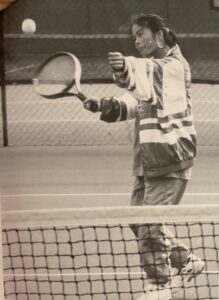
When JC was five years old, her father handed her her mother’s old racquet and started hitting balls with her in their driveway. He became her first coach and biggest supporter.
At the time, the family had few connections in the local sports community. So JC’s father took matters into his own hands.
He drove around local parks looking for tennis groups and eventually found a parks-and-rec team where JC could play. Because of residency rules, her participation had to remain somewhat quiet, but it gave her an early introduction to organized competition.
She also stood out as the team’s only Asian player at the time.
In many ways, though, tennis had already been part of her life since birth. Her parents met while playing tennis in California, and family photos show baby JC spending time courtside while they played.
“Tennis has just always been part of our family story.”
Chasing Competition
As JC grew older, her passion for the sport intensified. Recognizing her potential, her family made a significant decision: they moved from Waukesha to nearby Brookfield so she could attend a high school known for its state-championship tennis program.
The move paid off.
JC competed in both singles and doubles, eventually finding particular success in doubles play. At one point she and her partner were ranked #1 in the Western Region, a ranking that covered six Midwestern states.
Wisconsin’s high school tennis system is highly competitive because all schools compete within the same statewide structure rather than being divided into smaller regional classifications.
That level of competition helped attract the attention of college recruiters.
By the time JC graduated, she had received nine college offers, including two full athletic scholarships.
Her parents had a practical perspective on athletics. With another sibling already attending a costly private school, they saw sports as a pathway to education.
They even offered a simple incentive: if she chose the full scholarship option, they would buy her a car.
A Pragmatic Approach to College Tennis
JC accepted a Division I scholarship to Bowling Green State University in Ohio, competing in the Mid-American Conference.
From the beginning, she approached college tennis with a clear perspective.
“For me, tennis was never about going pro. It was about getting an education so that I could start my career.”
Being a Division I athlete required year-round commitment. Travel schedules often meant missing classes for tournaments and matches, making time management essential.
Determined to graduate on time, JC worked out a plan with her coach to take summer courses. The strategy allowed her to complete her degree in four years—something many student athletes struggle to accomplish.
During the summers she also worked as a tennis pro to help cover expenses.
She graduated with a degree in International Business with a marketing specialization, along with a minor in Spanish marketing.
But perhaps the most valuable lessons from college had little to do with academics.
Her parents had always emphasized humility and self-awareness.
“My parents taught me there will always be someone better than you. The important thing is knowing who you are – where you come from and understanding where you’re going.”
An Unusual First Career
After graduation, JC discovered that employers were eager to hire former athletes. The discipline, teamwork, and resilience required in competitive sports translated well to the professional world.
She ultimately received ten job offers.
Instead of choosing the most predictable path, she accepted what she describes as the “weirdest” one: a job in vertical transportation, working with elevators and escalators.
The role involved extensive travel and hands-on technical training.
For JC, it also offered something exciting—an opportunity to explore the United States while learning an entirely new industry.
That sense of curiosity and willingness to step into unfamiliar environments would eventually open doors to an entirely different field.
Breaking Into Tech
JC later joined Cisco in what the company openly described as an “experiment.”
Despite having no formal technical background, she was hired for her leadership potential and communication skills.
The transition required intense preparation. She spent eight months in Silicon Valley completing a rigorous training program designed to teach new hires the fundamentals of networking technology.
Despite initial skepticism from colleagues, she finished in the top third of her class.
Her work eventually included supporting the U.S. Department of Defense, traveling to military bases across the country and managing increasingly complex projects and teams.
Over time, JC took on larger leadership roles and later joined Amazon Web Services, helping build new teams during the early growth of cloud computing.
Advocating for Change
While working in tech, JC also experienced firsthand some of the challenges women still face in the industry.
She joined Amazon Web Services while pregnant, a decision that required confidence and advocacy.
At times she encountered comments suggesting she had been hired simply to fill a diversity quota or questions about balancing work and motherhood.
Rather than ignoring those experiences, she used them to push for broader conversations about representation and opportunity.
Later, she joined Microsoft to build the inclusive environment she believed the world needed more of. After growing and scaling large enterprises across the planet during the COVID pandemic-while pregnant again-it became obvious that a major life break was needed.
For many professionals, leaving a high-powered career can feel uncomfortable.
For JC, the decision was about something simpler: being present for herself and family.
Tennis, Parenting, and Perspective
Today, tennis is once again central in JC’s life—but in a new role.
Her children, Phoenix and Cillian, both play the sport, and JC has developed a thoughtful philosophy about how young athletes should experience competition.
Rather than focusing on wins and losses, she emphasizes enjoyment and personal growth.
Before each practice or match, her children identify one specific focus point—a simple goal that keeps their attention on the process rather than the outcome.
The family also celebrates what JC calls the “heck-yeah shots”—those moments when something finally clicks, and a player feels proud of the effort behind it.
“We celebrate the shots where they feel proud of themselves, not just the ones that win matches.”
Just as importantly, JC avoids coaching unless her children ask for help. Maintaining the parent-child relationship takes priority over sideline instruction.
Encouraging Curiosity
Reflection plays a big role in how JC helps her children learn from their experiences.
After matches, instead of offering critiques, she asks simple questions.
What did you notice?
What did you learn?
Those conversations help build awareness and confidence while keeping the focus on curiosity rather than judgment.
She also encourages her children to advocate for themselves—whether asking questions during practice or even preparing their own questions for doctor visits.
“Learning to ask good questions is one of the most powerful skills you can develop.”
Lessons That Extend Beyond the Court
Looking back, JC sees tennis as more than just a sport.
It is one of the few activities that combines individual responsibility with team dynamics. Players must perform on their own while contributing to the success of the group.
That balance helped shape her leadership philosophy in the workplace.
“Promotions don’t just come from your boss. They come from your peers.”
Today, she carries those same values into parenting and into the tennis community around her.
She encourages parents to trust coaches, support their children’s development, and stay present during practices and matches. Learning to be resilient enough as a parent to learn who their kids really are, not who they want them to be.
“Generally, our kids know what they need to do, but they don’t always have safe places to share how they feel. They need our ears and hearts, not our advice.”
Sometimes the most important moments happen quietly—between points, after a tough rally, or when a player realizes something new about their game.
For JC, those moments are where the real lessons of tennis live.
And they’re the lessons that last a lifetime.